


What Is a Mobile Compactor Storage System? A Complete Guide for Singapore Warehouses
What Is a Mobile Compactor Storage System?
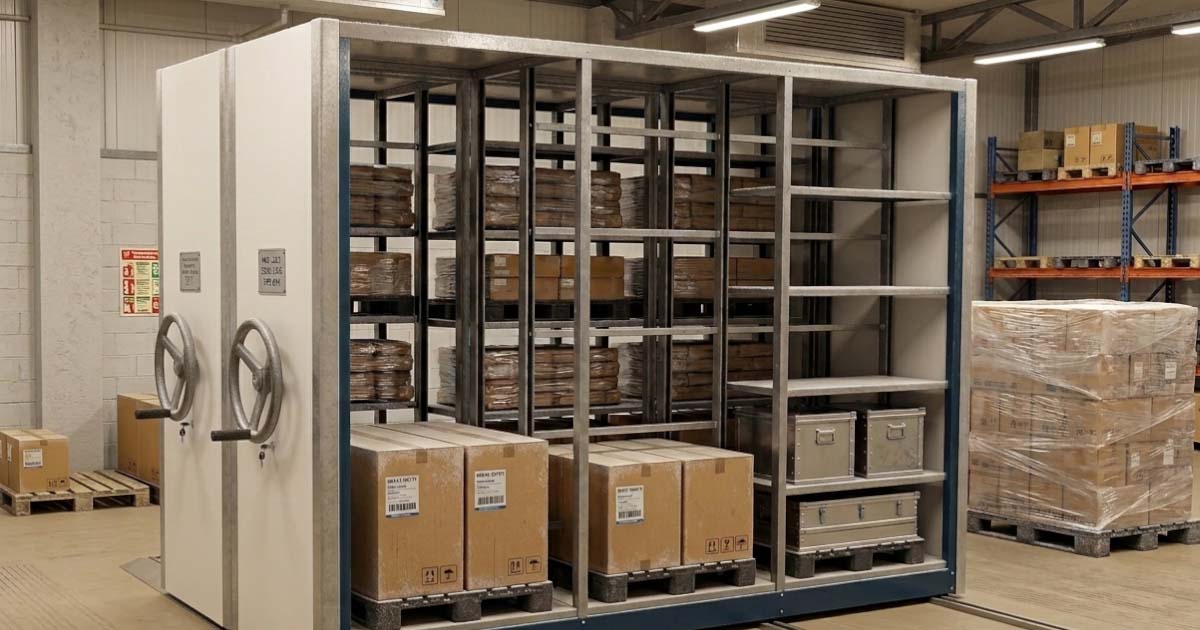
A mobile compactor storage system consists of shelving or racking units mounted on a base that runs along rails fixed to the floor. Because the units can be moved together or apart as needed, only one aisle has to be open at any time instead of leaving a permanent gap beside every row. This is what allows compactor storage to fit noticeably more shelving into the same floor area compared with a standard fixed layout.How the Mechanism Works
Most compactor systems move using a geared, chain driven mechanism. A handle on the end of the unit connects to gears and a roller chain, so turning the handle lets even a heavily loaded unit be shifted with comparatively little physical effort, in the same way a small gear can turn a much larger one with less force. Larger or higher traffic systems may use a motorized version instead, where units move at the push of a button rather than by hand, sometimes with sensors that stop movement if someone is standing in the aisle. Either way, the units run on rails set into or fixed on top of the floor, which keeps the movement smooth, level, and controlled rather than relying on loose castor wheels that can drift or catch on an uneven surface.Where Mobile Compactor Storage Is Used
Archive and records storage is one of the most common applications, since offices, law firms, and government departments often need to keep large volumes of documents without dedicating excessive floor space to them. Libraries and museums use similar systems for the same reason, fitting more shelving into rooms that were never designed to hold rows of fixed cabinets. Compactor storage is also used in temperature controlled or cold storage facilities, where reducing the footprint that needs to be cooled can help manage running costs, since a smaller cooled area generally means lower energy use. In general warehousing, compactor storage suits businesses stocking a wide range of SKUs that need to be kept accessible without expanding the building, since the saved aisle space can be used for additional shelving instead of sitting empty most of the time.Compactor Storage vs Static Shelving
| Factor | Compactor Storage | Static Shelving |
|---|---|---|
| Floor space efficiency | Higher, fewer fixed aisles needed | Lower, needs an aisle beside every row |
| Access | One aisle opens at a time | All rows accessible at once |
| Upfront cost | Generally higher due to rails and mechanism | Generally lower, simpler structure |
| Best suited for | Archives, cold storage, dense SKU ranges | Frequent, simultaneous multi-row access |
A Look at Gold Wind Engineering’s Mobile Compactor Shelving
Gold Wind Engineering’s Mobile Compactor Shelving is built with laser cut steel rails, heavy duty wheels, and a tested gear and chain mechanism designed for smooth, quiet movement. The system includes a central locking feature for added security and adjustable feet that allow installation without drilling into the floor. It is used across office filing, archive storage, and industrial environments that need efficient, high density storage.Conclusion
Compactor storage is a practical way to store more within the same floor area, whether for archived documents, temperature controlled goods, or a growing range of warehouse SKUs. It costs more upfront than static shelving, but the space it saves can make a real difference in a market where floor area comes at a premium. If you would like to find out whether compactor storage suits your space, contact Gold Wind Engineering for a consultation.Frequently Asked Questions (FAQ)
What is the difference between compactor storage and mobile shelving?
The terms are largely interchangeable. Mobile shelving is the broader term for shelving units that move on rails, while compactor storage usually describes the same system with an emphasis on the space it compacts or saves. Both work on the same basic principle of removing fixed aisles between rows.
Is compactor storage safe if someone is standing between the units?
Reputable compactor systems include safety features such as floor sensors, mechanical stops, or locking mechanisms that prevent units from closing while someone is inside the aisle. Even so, it is worth confirming what safety features are built into a specific system before installation, since designs can vary between suppliers.
Is compactor storage suitable for pallets, or just documents and small items?
It depends on the system. Lighter compactor shelving, like the type used for documents and archives, is generally not designed for palletised loads. However, heavier duty mobile racking versions built specifically for pallets do exist and are used in some cold storage and warehouse settings for the same space saving principle.
Can compactor storage be installed on an existing warehouse floor?
In most cases, yes, provided the floor is level and can support the load. Rails are typically fixed to or set into the existing floor rather than requiring a completely new foundation. A supplier should assess the floor and layout beforehand to confirm the site is suitable for installation.
Is compactor storage cost effective for a small office rather than a warehouse?
It can be, particularly where office or storage rent is high relative to the volume of documents or items being kept. For a small space with limited archive needs, static shelving may still be simpler and cheaper. Compactor storage tends to pay off once space is genuinely constrained.